
If you retire early—or even go part-time—your Social Security estimate might be off by hundreds of dollars per month. But the online tools won’t give you the answers you need—unless you really know how to use them.
Your Social Security statement assumes that you’ll keep working and earning the exact same income until you start taking your retirement benefits. But that’s going to be wrong for a lot of people. For instance, if you retire early at 55, Social Security’s estimate will be way off.
Continue reading below, or get similar information from this video.
Social Security does allow you to login and change your future earnings estimates. But here’s the problem: It assumes that your earnings will change now (like, when you’re doing the calculation—not at some point you choose in the future).
And, it assumes there will be no other changes until you claim. You can’t model a switch to a different job, going part-time, or any similar changes.
But maybe you don’t want to wait until the last minute to find out what you’re going to get. Plus, you need to find out how important your earnings are.
So, we’re going to walk through three different ways you can figure this out, starting with the easiest approach. I tested these and compared the output, and we’ll finish by reviewing those results.
Will It Matter?
For a lot of clients I’ve worked with, retiring early is not a huge deal for Social Security. The amount you get only shrinks by a small amount.
Still, this is something you have to check. I recently went through this exercise with a client, and we found that her benefit would drop by about $1,300 per month if she stops working. In this case, she’s in her mid 50s and didn’t work a job that pays into Social Security until later in life.
Inside Your Account
So let’s look at the easiest way to try and figure this out. Start by logging into your Social Security account at SSA.gov. On the first page after you log in, scroll down to where it says Retirement Calculator.
You’ll see a little chart with your benefit at different ages, but you need to click just above that chart where it says Average Future Annual Salary. There’s a dropdown arrow, and this is where you’ll be able to make updates.
Enter zero in the box, and click Calculate.
You’ll notice that the chart below updates, showing what your benefit would be if you stop earning and paying into the system starting now.
This is what we’re looking for. How different is that number from what was showing before? You can switch back and forth and have it go back to your last reported income, if you want.
If the difference is big, it tells you that your earnings are still important. As you continue to work and pay into the system, you’re probably helping yourself get a bigger monthly payment. That’s especially true if you’re in your highest earning years, as is often the case in your 50s and 60s.
Most of the clients I work with have worked and paid into the system for decades. In those cases, we usually find that they’ll lose a few dollars per month—usually it’s less than $100 per month—if they’re currently in their 50s or 60s.
But again, there are exceptions, so you need to check.
With this calculator, you can also see a table below the chart, and if you choose to print or save a copy, you’ll get a slightly different looking table.
You can repeat this process multiple times, and each new income number gives you a new set of estimates at age 62, FRA, and age 70. That might be interesting if you’re evaluating different options like part time work or switching jobs.
This is helpful information, but you’ll notice that there’s nowhere to enter exactly when you want your income to change. The assumption is that you’ll switch to the new income (whether that’s zero or something else) this year. You can’t say “Switch to zero in five years, and then I’ll claim benefits five years after that.”
So, we usually end up with information that’s not entirely accurate for the situation. It ends up being a conservative estimate, because if you plan to stop in five years, but we’re assuming you stop paying into the system today, your benefit should be a bit better than what appears on the chart. We’re ignoring five years of earnings.
So, what can you do about that?
SSA Online Calculator
If you want more control over your future income and when your income stops, you can use a different calculator from Social Security.
The online calculator allows (or requires, depending on how you look at it) you to enter your earnings history year-by-year so that you’re using real data from your history.
To get that information, you’ll need to log into your account. On the main screen, look for “Review your full earnings record now” under your Eligibility and Earnings. Then, click on those words, and you’ll get your year-by-year earnings history.
Go ahead and take a stroll down memory lane while you’re on that page. You’ll see every year of reported earnings, and you might find yourself reminiscing about your first job, some interesting twists and turns in life, etc. It’s always interesting to look back, even if the trigger as unexpected and boring as your Social Security statement that makes it happen.
Anyway, use that information to fill in the boxes. I suggest using keyboard shortcuts to copy and paste so you can keep it quick and accurate. You’ll also need to enter your date of birth, and I like to keep everything in today’s dollars, for now.
It’s probably best to start with FRA for your “Age at retirement.” We want to compare this to your Social Security statement and make sure they’re consistent before we start tweaking things. So, enter the latest earnings from your history, and use that same number for the expected future earnings.
And you might notice that this calculator is a little behind, but it’s what we’ve got.
At this point, we have something that should more or less resemble your Social Security statement. So, click Calculate, and see if the monthly retirement benefit matches your FRA benefit from your statement or from your online estimate.
This probably won’t match perfectly. I’ll share some comparisons I did while testing a bit later, but it should be close enough.
Now that you’ve got a baseline established, it’s time to start playing with the numbers. The two areas you’ll probably change are the “Age at retirement” up at the top, and the future earnings, near the bottom.
This calculator has a bit more customization than the last one, because you can:
- Pick a time in the future (and before your claiming date) when your income will be zero.
- Change your future earnings, starting now, just like on the last calculator.
The retirement age is interesting, because if you enter an age lower than 62, this calculator is only going to show your monthly benefit at age 62 farther down the page. So, that’s unfortunate, but you can still get some decent information here.
Again, the main thing you’re looking for is how big the differences are when you change your future income or you retire early. Is it a big difference, or a small change?
Now, if this is still not getting you what you need, the next step is to look at financial planning software.
Retirement Planning Software
There are several programs out there that will use your actual earnings history, which I think is important. That’s almost certainly better than having a calculator estimate your benefit based on your most recent earnings. Your income last year doesn’t paint a picture of all the previous decades of your life, so I really think you want to use your earnings history whenever possible.
Most of the options I’m aware of are paid programs, but there might be some free DIY options out there. When it comes to DIY, the main one that comes to mind is MaximizeMySocialSecurity, but do some research to figure out what else is out there.
I have Right Capital and Income Lab, and both of those allow me to enter the earnings history manually. It’s a lot like that online calculator, where you have a bunch of boxes, and you fill it out year-by-year. By the way, I believe MaximizeMySocialSecurity has you upload an earnings file instead of typing in the annual earnings.
These programs are designed for maximum customization, and they can be a little confusing if you’re not familiar with all of the rules—and with retirement planning, in general. They’ll typically inflate everything, and they’re looking at the earnings test if you claim early, they calculate spousal benefits, and a lot more.
Anyway, they can also account for changes in your income, which you can customize as much as your heart desires: Change your income every year, or take a few years off, whatever.
As you change the retirement age, these calculators know that you’ll stop paying into Social Security, and you should see your benefit change, as well.
Perhaps most importantly, you can change both the retirement and claiming ages to answer questions like: What if I work for five more years, retiring at 63, and then claim at age 70?
So if you want maximum customization, a more advanced calculator is the way to go.
The Social Security Administration also has a tool you can download and install, and it allows for some customization, as well. It’s been a while since I used that tool, and you can certainly give it a try, but I was not thrilled with it, and I think the other tools are easier to work with.
How Different Methods Compare
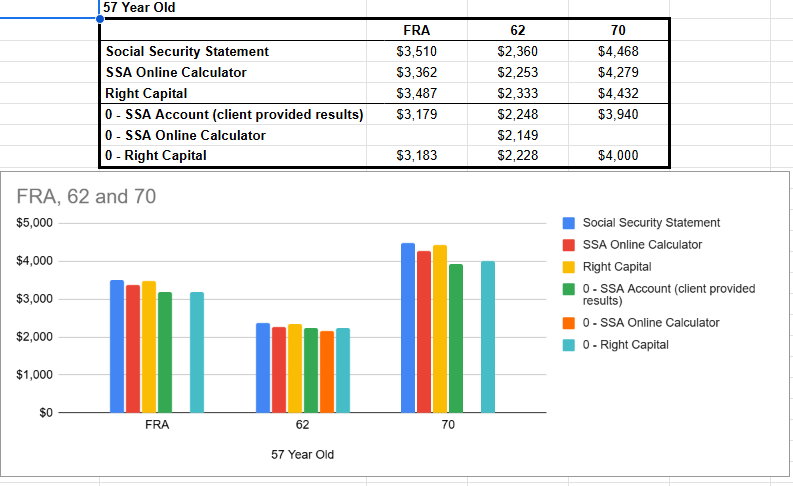
So how do all of these calculations compare? It’s important to remember that we’re not going to get every tool to give the same output down to the dollar. Different tools use different assumptions and methods, and we’re predicting the future anyway, so that’s okay.
For the questions I’m interested in, they all seem to be reasonably consistent. But again, there are some answers you can’t get from the online Social Security tools.
I usually want to know two things when I’m working with a client:
- How much does your future income matter for your Social Security benefit? If you retire early, is that going to derail things?
- How much income can we expect under different scenarios?
Here you can see test results for a 57 year old who has a pretty full work history, but there was some time away for caregiving. I have her statement, and she also went into her account to set future earnings to zero and sent me a copy of the output.
The top line is the statement value from SSA, which is our baseline. And yes, they’re out of order, but I’m the type of guy who keys everything off FRA, so that goes first.
She’d get $3,510 if she keeps working until FRA, and we can see that the other two calculators produced a similar benefit.
But if she stops working today, the benefit drops to more like $3,180. You’ll see that the online calculator couldn’t even give us an answer, because again, it only tells you the benefit at age 62 if you stop working before then.
At age 62 we can get answers from all of them, and again we have a blank for age 70.
You can see all of this in a graph if that’s helpful. And by the way, if you’re finding this helpful, please leave a quick thumbs up.
The results are pretty interesting, with the online calculator currently coming in lower. And the bars on the right side for each age are the cases where there’s zero future income. That’s the green, orange, and bluegreen.
So the question becomes whether or not it makes sense to keep working, and that of course, depends on everything else going on in your life and your finances. But with this information, you’re better prepared to decide.
FAQs
How much does early retirement affect Social Security benefits?
Retiring early typically results in fewer years of earnings being reported to Social Security, which might reduce retirement benefits by a small amount (less than $100 per month, for example) for people in their late 50s or 60s who’ve worked for decades. However, some cases can see reductions of $1,000+ monthly, especially if you started paying into Social Security later in life or took breaks for caregiving or other reasons. Early claiming (as opposed to early retirement) can dramatically reduce your benefits further.
Can I calculate my Social Security benefits if I retire early using SSA.gov?
Yes, log into SSA.gov’s Retirement Calculator and set “Average Future Annual Salary” to zero to see benefits if you stop working now. However, this assumes you stop earning immediately, not at a future date you choose. You may want to use different methods if you’ll retire in a few years.
Why is my Social Security estimate wrong if I plan to retire early?
Your Social Security statement assumes you’ll keep earning the same income until claiming benefits. If you retire early at 55, this estimate will be wrong because it won’t account for years of zero earnings. You need a calculation that will assume zero earnings and find your highest 35 years of earnings.
What’s the best way to get accurate Social Security projections for early retirement?
Use retirement planning software like MaximizeMySocialSecurity, Right Capital, or Income Lab that accepts your complete earnings history. These allow you to customize when income changes and model different retirement and claiming age scenarios.
What happens to my Social Security benefit if I get laid off or stop working earlier than expected?
Getting laid off or stopping work earlier than planned will reduce your Social Security benefit, but the impact is typically small if you’ve worked for decades. The reduction depends on your earnings history and how many high-earning years you’re missing from the calculation. The impact might be smaller than you think, especially if you have 35+ years of earnings history.
Can you help me figure out my retirement income if I retire early?
Yes, as a fee-only CFP® professional, I often help clients review the big picture, including how early retirement might affect Social Security benefits and other aspects of retirement. See the Pricing page to learn how we work together.